
Most SEO professionals still think of the individual article as the unit of retrieval — the page Google reads, chunks, and cites inside an AI Overview. That assumption is increasingly incomplete. What I observed recently points to something the industry has largely overlooked: Google's AIO crawler is treating blog listing page excerpt text as independent, citable content chunks — pulling the preview snippets visible in card grids directly as grounding material, separate from the full articles they link to.
If you manage a content-heavy website, this changes how you should think about every line of copy on your blog index page, your hub pages, and any listing template that renders article excerpts. The excerpt is no longer just a teaser for the reader. It is a retrieval surface in its own right.
Is your content architecture optimized for AI retrieval?
Get a free audit of your site's AIO visibility — including how your hub pages and listing pages are being read by Google's AI crawler.
How Google's AIO Retrieval Pipeline Actually Works
To understand why this matters, it helps to understand what happens before an AI Overview appears on screen. Google does not simply feed a search query into Gemini and let the model answer from memory. The system uses a process called retrieval-augmented generation (RAG) — it first retrieves a set of candidate documents from the live web, extracts specific text passages from those documents, and then uses those passages as grounding material to generate the AI response.
The retrieval stage is not page-level — it is passage-level. Google's passage indexing system allows the search index to evaluate and rank individual passages within a page independently of the page as a whole. This means a single URL can contribute multiple discrete chunks to the retrieval pool. The AIO system then selects the most semantically relevant chunks from across those candidate documents and uses them to construct its grounded answer.
What determines which chunks get selected? Research into Google's grounding pipeline suggests the system favors passages that are self-contained, factually specific, and directly responsive to the query — passages that could stand alone as an answer without requiring the surrounding context to make sense. The grounding budget is finite, estimated at approximately 2,000 words per query distributed across three to five primary source documents. Every word in that budget has to earn its place.
The Finding: Listing Pages as Independent Citation Surfaces
Here is where the observation departs from what most AIO research covers. The standard assumption is that the retrieval unit is the article page — the full URL that a blog post lives at. The listing page (your /blog/ index, your hub page, your category archive) is treated as navigational infrastructure: useful for crawling, useful for internal link equity, but not a meaningful content surface for AI retrieval.
That assumption appears to be wrong. What I observed is that Google's AIO crawler is pulling excerpt text directly from blog listing pages — the short preview snippets that appear in card grids — and treating those excerpts as citable chunks in their own right. The crawler is not just following the links from the listing page to the individual articles. It is also reading the listing page itself as a document, extracting the visible text from each card, and indexing those excerpts as discrete passages.
This means the excerpt copy rendered on your /blog/ page — typically the first one or two sentences of each article, or a manually written summary — is being evaluated as a standalone retrieval candidate. If that excerpt is well-written, specific, and semantically relevant to a query, it can surface in an AI Overview citation pointing to your listing page URL, not to the individual article.
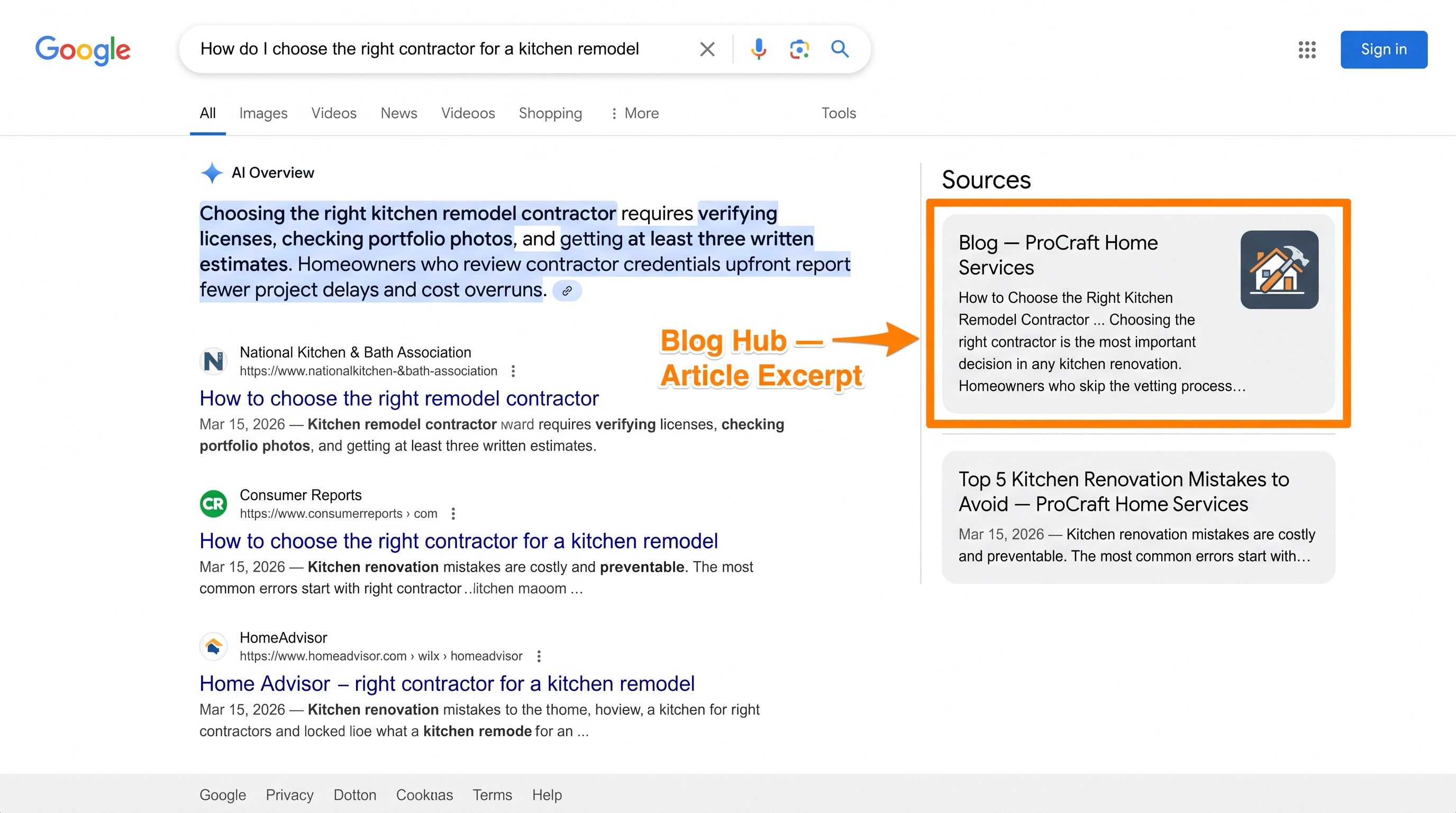
A fictional example illustrating the pattern: the AIO citation on the right panel points to the blog hub/listing page URL, not the individual article — because the excerpt text on the listing page was the retrieved passage.
Why This Is Different From What We Already Knew
It is worth being precise about what is genuinely new here, because several adjacent ideas are already well-established. Open Graph descriptions and meta descriptions influencing click-through rates is old news. The relationship between excerpt text and traditional organic snippets has been understood for years. "Write strong introductions" is standard content advice that predates AI Overviews entirely.
What is different is the mechanism and the surface. The established understanding is that Google reads the article page and may use its opening paragraph as a snippet. The new observation is that Google is also reading the listing page — a page whose primary purpose is navigation, not content — and treating the excerpt text rendered there as an independent passage eligible for grounding. The listing page itself has become a citation surface, not just a crawl gateway.
This distinction matters because it changes what you optimize and where. If the excerpt on your listing page is auto-generated from the first 150 characters of the article body, you may be leaving a retrieval opportunity on the table. If it is a manually crafted, query-responsive summary, it becomes a second chance to appear in an AI Overview for the same topic — from a different URL, with different anchor text, pointing back to your hub.
What This Means for How You Structure Hub and Index Pages
The practical implication is straightforward: every excerpt on a listing page should be written as if it were a standalone answer to the query the article targets. Not a teaser. Not a truncated sentence. A self-contained, factually grounded summary that could stand alone as a useful response to a search query.
Weak excerpt (teaser-style)
"Law firms face unique challenges when it comes to ranking on Google. In this article, we explore..."
Strong excerpt (retrieval-optimized)
"Law firms in competitive markets rank faster on Google Maps when their GBP category, service-area pages, and review velocity are aligned. Here's the framework we use with Broward County practices."
The second version is self-contained. It answers a real question in two sentences. It names a specific geography. It references a specific mechanism. It is the kind of passage a grounding system selects because it is directly responsive and factually specific.
The same logic applies to hub pages. If you have a regional hub page that links to city-level pages, the introductory paragraph and the summary text beneath each city link are now retrieval candidates. Writing those summaries with the same care you would apply to an article introduction is no longer optional — it is part of your AI search optimization surface.
The Broader Implication for Topical Authority
There is a second-order effect worth noting. When a listing page gets cited in an AI Overview, it signals to Google that the page itself carries semantic authority on the topic — not just as a navigation layer, but as a content document. This reinforces the topical authority of the hub, which in turn strengthens the internal link equity flowing from the hub to the individual articles it links to.
In other words, a well-optimized listing page does not just help the articles it links to rank better through internal links. It can now contribute directly to topical authority signals by earning its own AIO citations. The hub and the articles it contains become mutually reinforcing retrieval surfaces rather than a one-way link funnel. This is a meaningful shift in how to think about content architecture — and it applies equally to law firm SEO, local SEO, and any content-driven vertical where hub pages are part of the architecture.
What to Audit Right Now
Pull up your blog index page and read the excerpt text for each article as if you had never read the article itself. Ask: does this excerpt answer a real question on its own? Does it name a specific outcome, mechanism, or geography? Could it stand alone as a useful response to a search query?
If the answer is no — if the excerpts read like teasers, or if they are auto-truncated sentences that cut off mid-thought — rewrite them. Treat each excerpt as a 30–50 word answer to the query the article targets. Apply the same discipline you would to a meta description, but with the added constraint that the text must also make sense as a standalone passage when read in isolation by a retrieval system that has no surrounding context.
Do the same for your hub pages. Every summary block, every city description, every service teaser on a hub page is now a candidate for passage-level retrieval. The retrieval surface is larger than most SEO professionals currently account for. The listing page is part of it.
Frequently Asked Questions
Want to know how your site's content architecture performs in AI search?
I audit hub pages, blog listing pages, and content clusters for AIO retrieval readiness — and show you exactly what to rewrite and why.