Right now, a potential customer is asking ChatGPT which service provider to use in your industry. Another is running a query on Perplexity looking for a comparison between you and your competitors. A third is typing something into Google and seeing an AI-generated summary before they ever reach the blue links. In all three cases, your business is either present or it isn't — and the strategies that determine which outcome you get are not the same ones that worked three years ago.
The businesses that are winning in this environment are not the ones with the biggest budgets. They are the ones that understood early that AI search optimization is not a single channel — it is three distinct systems with overlapping but meaningfully different requirements. Getting all three right simultaneously is the challenge. Getting only one right while neglecting the others is the mistake most businesses are currently making.
Is your business showing up in AI search results?
Get a free AI visibility audit and find out where your brand stands across ChatGPT, Perplexity, and Google SGE.
Three Platforms, Three Different Problems
The first mistake businesses make when approaching AI search is treating it as a monolith. ChatGPT, Perplexity, and Google's AI Overviews are built on fundamentally different architectures and serve fundamentally different user intents. A strategy that works brilliantly for one can be entirely ineffective for another — and a strategy that ignores the differences between them produces mediocre results across the board.
ChatGPT's responses are shaped by a combination of training data and, in its browsing-enabled modes, real-time retrieval. The businesses that appear in ChatGPT's recommendations tend to be those with strong brand entity signals — consistent mentions across authoritative sources, clear topical associations, and a digital footprint that makes it easy for a language model to understand what the business does and who it serves. This is why building a topical authority content strategy is no longer optional for businesses that want to be cited by AI systems — it is the foundation.
Perplexity operates as a retrieval-augmented system that actively searches the web to construct its answers. This means the factors that influence Perplexity citations are more immediately actionable than those that affect ChatGPT's training data. Content quality, topical depth, domain authority, and the specificity with which your pages answer real user questions all play a direct role in whether Perplexity chooses to cite your business. A well-executed content engineering strategy — one built around answering the exact questions your audience is asking — is what moves the needle here.
Google's AI Overviews — the evolved form of SGE — sit at the intersection of traditional search ranking and AI synthesis. They draw from pages that Google already trusts, which means your traditional SEO foundation matters enormously here. But they also favor content that is structured for synthesis: clear answers, well-organized sections, and the kind of authoritative depth that makes it easy for an AI to extract and present information confidently. A solid technical SEO audit ensures your pages are structured in a way that Google's AI can actually read and synthesize from.
The Shared Foundation That Powers All Three
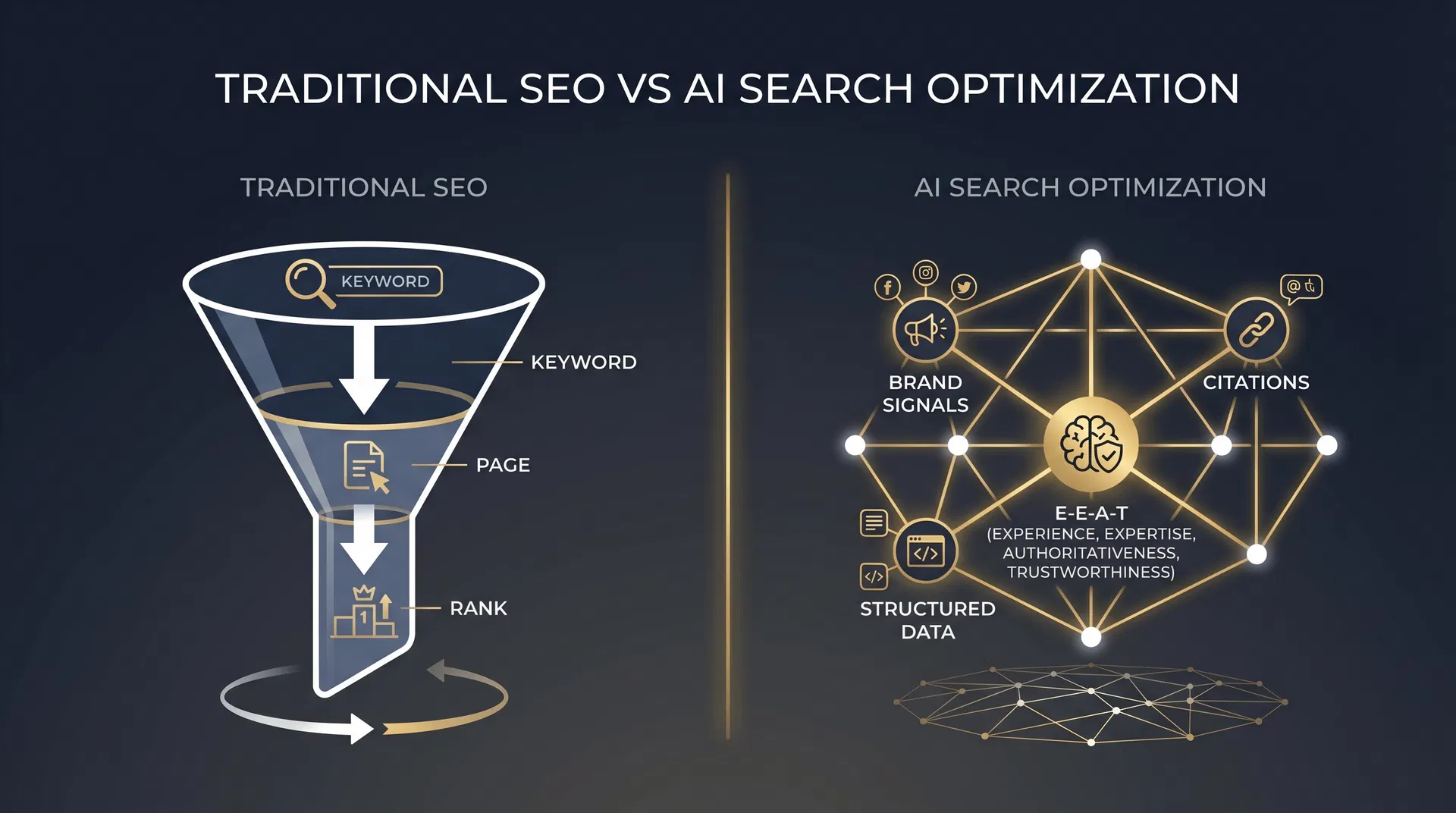
Despite their differences, ChatGPT, Perplexity, and Google SGE share a common denominator: they all reward businesses that have built genuine authority around a specific topic or domain. The concept of E-E-A-T — Experience, Expertise, Authoritativeness, and Trustworthiness — which Google formalized for its human quality raters, has become the de facto standard that all three AI systems use to evaluate whether a source is worth surfacing.
This means the most efficient approach to multi-platform AI visibility is to build a content and authority infrastructure that satisfies E-E-A-T at its core, and then layer on the platform-specific optimizations that each system requires. Businesses that try to optimize for each platform in isolation end up with fragmented strategies that are expensive to maintain and inconsistent in their results.
The structural work — building topical depth, earning citations from credible sources, establishing consistent brand entity signals across the web — is the same work that makes a business visible across all three platforms. This is why AI & Search Everywhere optimization is best approached as a unified strategy rather than three separate workstreams. The platform-specific layer is real but thinner than most people assume. A well-structured keyword and query strategy that maps to how people ask questions across all three platforms is what ties the entire system together.
Where Most Businesses Are Getting It Wrong
The most common failure mode I see is businesses that have invested heavily in traditional SEO — good rankings, solid technical foundation, decent content — but have done nothing to build the brand entity signals that AI systems rely on. They rank well in Google's blue links but are essentially invisible in AI-generated answers, because AI systems don't just look at your website. They look at what the broader web says about you.
A business that has 50 pages ranking on page one of Google but has no meaningful presence in industry publications, no citations in relevant directories, no mentions in forums or communities where their audience congregates — that business has a Google strategy. It does not have an AI search strategy. This is especially acute for high-stakes niches like law firm SEO, SaaS SEO, and local business SEO, where AI-generated recommendations are increasingly the first touchpoint in the buyer journey.
The second failure mode is content that is optimized for keywords but not for questions. AI systems are fundamentally question-answering machines. They are looking for content that directly, specifically, and authoritatively answers the questions their users are asking. Content that is written to rank for a keyword phrase but doesn't actually answer the underlying question in a clear, structured way is content that AI systems will pass over in favor of something more useful.
The third failure mode — and perhaps the most underappreciated — is inconsistency. AI systems build their understanding of a business from dozens of signals across the web. When those signals are inconsistent — different descriptions, different service lists, different geographic claims — the AI's confidence in surfacing that business drops. Consistency is not glamorous, but it is foundational to AI visibility in a way that most businesses haven't fully internalized yet.
Is your brand showing up where your customers are searching?
Gilbert builds AI search visibility strategies that work across ChatGPT, Perplexity, and Google SGE — without splitting your budget across three separate campaigns.
The Compounding Advantage of Getting Ahead Now
AI search is not a future trend — it is the present reality for a growing share of your potential customers. The businesses that are building their AI visibility infrastructure now are not just winning searches today. They are establishing the brand entity signals, citation networks, and content authority that will make them the default answer in their category as AI search continues to grow.
The window for first-mover advantage in AI search is closing. In most industries, the businesses that establish strong AI visibility in 2026 will be significantly harder to displace in 2027 and beyond — for the same reason that early movers in traditional SEO built authority moats that took years for competitors to overcome. The mechanisms are different, but the compounding logic is identical.
The question is not whether AI search will matter for your business. It already does. The question is whether you will be the business that shows up in those answers — or the one that watches a competitor take that position while you're still debating whether to act. The businesses that pair their AI search optimization with a strong topical authority content strategy are the ones building durable, compounding visibility — not just a spike that fades.
How the Three Platforms Differ
| Platform | Primary Signal | Optimization Horizon |
|---|---|---|
| ChatGPT | Brand entity signals, training data coverage, consistent web presence | Medium–Long (months) |
| Perplexity | Content quality, topical depth, domain authority, real-time retrieval | Short–Medium (weeks) |
| Google SGE / AI Overviews | Traditional SEO authority + structured, synthesis-friendly content | Medium (weeks–months) |