
What Topical Authority Actually Means
Topical authority is Google's assessment of how completely a website covers a subject area. It is not a single score or a metric you can look up in a dashboard — it is an emergent property of your site's content architecture, internal linking, and the semantic relationships between your pages.
Think of it this way: if someone asked you to recommend the single most knowledgeable person in Broward County on family law SEO, you would not choose someone who wrote one blog post about it. You would choose the person who has written extensively about divorce attorney SEO, child custody keyword strategy, local pack optimization for family lawyers, GBP management for law firms, and content marketing for family law practices — and who has connected all of those ideas into a coherent body of work. Google makes the same judgment about websites.
This is why a topical authority strategy produces compounding returns: once Google recognizes your site as the authority on a subject, it begins ranking you for queries you never explicitly optimized for — because it trusts that your coverage is complete enough to satisfy any related search intent.
How It Differs from Domain Authority and Backlink-Based SEO
For most of the 2010s, SEO was a backlink arms race. The site with the most links from authoritative domains won. Domain Authority (DA), a metric created by Moz, became the proxy for ranking potential. Agencies sold link-building packages. Guest posts proliferated. Private blog networks emerged. And for a while, it worked.
Then Google's Helpful Content Update, the E-E-A-T framework, and a series of spam-focused core updates systematically dismantled that model. Sites that had accumulated thousands of low-quality backlinks saw their rankings collapse. Sites that had built genuine topical depth — even with modest link profiles — held firm or improved.
The critical distinction is this: backlinks are an external signal that anyone can manufacture. Topical authority is an internal signal that requires genuine, comprehensive content — and it is far harder to fake. For a law firm investing in SEO, this means that building a well-structured content cluster around your practice areas will outlast any link-building campaign, because it is aligned with what Google is actually trying to measure: expertise.
The Pillar-Cluster Model: How to Build It
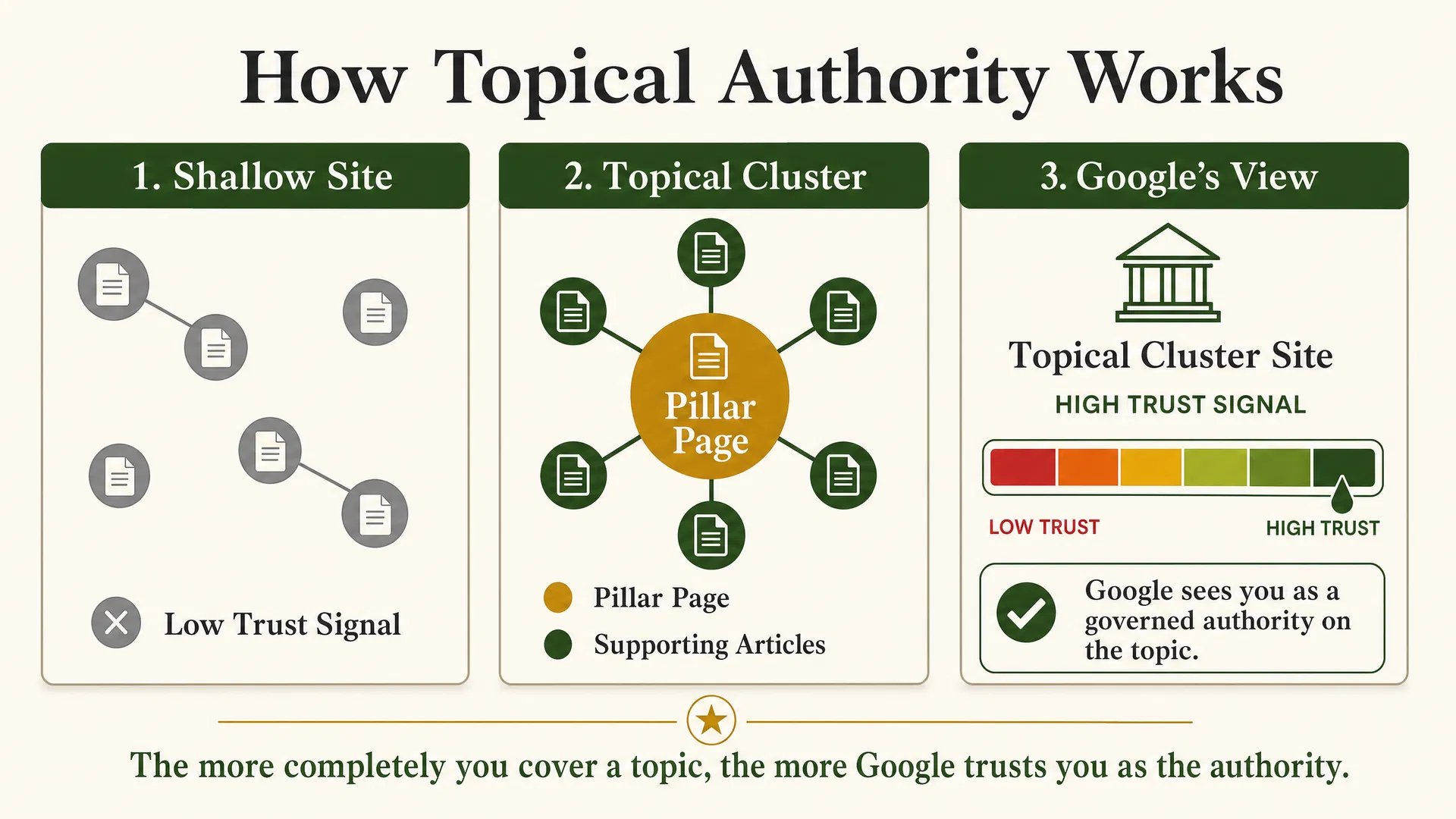
The practical implementation of topical authority is the pillar-cluster model. A pillar page is a comprehensive, long-form resource covering a broad topic — for example, "SEO for Law Firms in Broward County." Cluster pages are shorter, more specific articles that address individual subtopics: divorce attorney SEO, personal injury law firm local pack strategy, criminal defense content marketing, GBP optimization for family lawyers, and so on. Every cluster page links back to the pillar, and the pillar links out to each cluster.
This structure does three things simultaneously. First, it signals to Google that your site covers the topic from multiple angles, not just one. Second, it concentrates internal link equity on the pillar page, which is typically the page you most want to rank for high-volume queries. Third, it creates a crawl path that makes it easy for Googlebot to discover and index every page in the cluster — directly addressing the crawl budget issues that cause thin or isolated pages to drop out of the index.
For a Coral Springs business, this means your Coral Springs SEO hub page should function as a pillar — with dedicated cluster pages for each service (technical SEO, local SEO, content marketing, GBP optimization) and each practice area (law firms, medical practices, credit unions, small businesses). Each cluster page reinforces the hub's authority, and the hub passes authority back down to each cluster.
Why Topical Authority Survives Every Algorithm Update
Google's core updates are not random. They share a consistent direction: reward sites that demonstrate genuine expertise, authoritativeness, and trustworthiness (E-E-A-T), and penalize sites that exploit technical loopholes. Every major update since 2022 — Helpful Content, the March 2024 Core Update, the AI Overviews rollout — has moved the needle further in the same direction.
Topical authority is structurally aligned with this direction. It cannot be built through shortcuts. It requires original, accurate, well-organized content that genuinely serves the reader's intent. When Google updates its algorithm to better identify expertise, sites with strong topical authority benefit — because they already have what the update is trying to surface. This is why content engineering and keyword strategy built around topical clusters consistently outperform campaigns built around individual keyword targets.
For law firms specifically, this is a significant competitive advantage. Most law firm websites are built around practice area pages with thin, templated content and no supporting cluster. A firm that invests in legal content marketing and builds a genuine topical cluster around its practice areas will not just rank better today — it will be insulated from the next three algorithm updates, because its content is exactly what those updates are designed to reward.
Topical Authority for South Florida Law Firms and Local Businesses
The local SEO landscape in Broward County is uniquely suited to a topical authority approach. National SEO agencies dominate broad queries like "SEO services" or "law firm SEO" — but they cannot compete on local specificity. A Coral Springs business that builds topical authority around "SEO for law firms in Coral Springs" or "divorce attorney SEO in Broward County" is competing in a much smaller pool, where depth of coverage matters more than domain age or backlink count.
This is the strategy behind the technical SEO framework for Coral Springs legal websites and the multi-location law firm SEO system used for Broward County firms with offices in multiple cities. Each of those pages is a cluster node — and together they form a topical cluster that signals to Google: this site understands law firm SEO in South Florida at a level no generalist agency can match.
The same principle applies to local business SEO across industries — whether you are a credit union in Coral Springs, a medical practice in Fort Lauderdale, or a multi-location firm with offices from Boca Raton to Pembroke Pines. Topical authority is not a law firm strategy; it is a Google strategy. And it works for any business willing to invest in genuine expertise.
| Factor | Keyword-Only SEO | Topical Authority SEO |
|---|---|---|
| Algorithm update risk | High — relies on exploitable signals | Low — aligned with Google's direction |
| Time to results | Faster short-term | Slower start, compounding long-term |
| Ranking breadth | One keyword at a time | Entire topic clusters simultaneously |
| Competitive moat | Easy to replicate | Hard to replicate — requires real content |
| AI search visibility | Minimal — thin pages not cited | High — comprehensive pages cited by LLMs |
| Cost over time | Ongoing spend to maintain | Decreasing cost as authority compounds |
How to Start Building Topical Authority Today
The first step is a topical gap audit: identify every subtopic within your core subject that a potential client might search for, then map which of those subtopics your site currently covers and which it does not. The gaps are your content roadmap. A law firm that covers "divorce attorney SEO" but not "child custody SEO," "alimony keyword strategy," or "family law local pack optimization" has an incomplete cluster — and Google can tell.
The second step is internal linking architecture. Every cluster page must link to the pillar, and the pillar must link to every cluster. Orphaned pages — pages with no inlinks from other pages on your site — are invisible to Google regardless of how good the content is. This is why the technical SEO audit always precedes content creation: you need to know the current link architecture before you can improve it.
The third step is consistency. Topical authority is not built in a single sprint — it accumulates over months of regular publishing. A realistic cadence for a law firm or local business is one to two cluster articles per month, each one filling a specific gap in the topical map. Within six to twelve months, the compounding effect becomes visible: rankings improve across the entire cluster, not just for the pages you directly optimized.
Frequently Asked Questions
What is topical authority in SEO?
Topical authority is a measure of how comprehensively a website covers a specific subject area. Google uses it to determine which sites deserve to rank for an entire topic — not just individual keywords. A site with high topical authority on 'family law SEO' will rank for dozens of related queries because Google trusts it as the definitive resource on that subject.
How is topical authority different from domain authority?
Domain authority (DA) is a third-party metric based primarily on backlink quantity and quality. Topical authority is Google's internal assessment of how thoroughly your site covers a subject. A newer site with no backlinks can outrank an older, high-DA site if it covers a topic more completely — which is exactly why topical authority is the more actionable strategy for local businesses and law firms.
How many articles do I need to build topical authority?
A practical starting point is one pillar page (2,000+ words) supported by 6–12 cluster articles (800–1,500 words each). For a law firm, a pillar on 'family law SEO' might be supported by articles on divorce attorney SEO, child custody SEO, alimony keyword strategy, and local pack optimization for family lawyers.
Does topical authority work for local businesses in Coral Springs?
Yes — and it works especially well for local businesses because the competition is far lower than national markets. A Coral Springs law firm that builds complete topical coverage of 'family law SEO in Broward County' will outrank national SEO agencies for local queries because Google prioritizes geographic relevance combined with topical depth.
Will topical authority protect my rankings from Google algorithm updates?
No SEO strategy is completely immune to algorithm changes, but topical authority is the most durable approach available. Google's core updates consistently reward sites that demonstrate genuine expertise and comprehensive coverage — which is exactly what topical authority builds. Sites relying on keyword stuffing or thin content lose rankings with each update; topically authoritative sites tend to gain.
Ready to Build Topical Authority for Your Law Firm or Business?
Gilbert audits your current content cluster, identifies the exact gaps that are costing you rankings, and builds a 90-day topical authority roadmap tailored to your market — whether you're in Coral Springs, Fort Lauderdale, Pembroke Pines, or anywhere in Broward County.