Senior SEO Strategist · Rodriguez Search
The phrase "AI employee" has gone from science fiction to boardroom agenda in under 18 months. Microsoft, Google, Salesforce, and dozens of enterprise software vendors are racing to ship autonomous AI agents that can research, write, analyze, schedule, and execute tasks without a human in the loop. For businesses investing in search visibility, this shift is not a distant future concern — it is already reshaping how search engines discover, evaluate, and rank content right now.
This article explains what AI agents actually are, why Google's own engineering leadership is calling for a new optimization discipline called Agentic Engine Optimization (AEO), and — most importantly — how we integrate AI agent capabilities into every service we offer to deliver faster, higher-quality results for law firms and local businesses across South Florida.
What Are AI Agents — and Why Is Everyone Talking About Them?
An AI agent is an autonomous software system that perceives its environment, sets goals, plans actions, and executes tasks without step-by-step human instruction. Unlike a chatbot that responds to a single prompt, an agent can chain multiple actions together: search the web, read a document, write a report, send an email, and update a spreadsheet — all in one uninterrupted workflow.
In April 2026, Addy Osmani, Google Cloud AI's director of engineering, published a landmark article introducing the concept of Agentic Engine Optimization (AEO) — the practice of structuring and serving content so AI agents can efficiently fetch, parse, and act on it. Osmani's core insight: AI agents don't browse websites the way humans do. They operate on machine-readable representations — raw HTML, accessibility trees, or screenshots — and they have limited "patience for preamble." Pages that front-load their answers within the first 500 tokens, use clean semantic markup, and stay within token-efficient length ranges perform dramatically better in agentic contexts than bloated, preamble-heavy pages.
This matters for SEO because AI Overviews, Perplexity, ChatGPT search, and other AI-driven answer surfaces all use agent-like retrieval systems. A page that is invisible to an AI agent is increasingly invisible to the users those agents serve.
The "AI Employee" Hype: What's Real and What's Marketing
The "AI employee" framing — popularized by vendors like Salesforce (Agentforce), Microsoft (Copilot agents), and HubSpot (Breeze agents) — describes AI systems that can autonomously handle defined business workflows: answering customer inquiries, qualifying leads, scheduling appointments, or generating performance reports. A 2026 McKinsey survey found that 59% of companies are investing $1M or more annually in agentic AI, and 72% of marketing leaders expect AI agents to handle at least one full workflow end-to-end by the end of 2026.
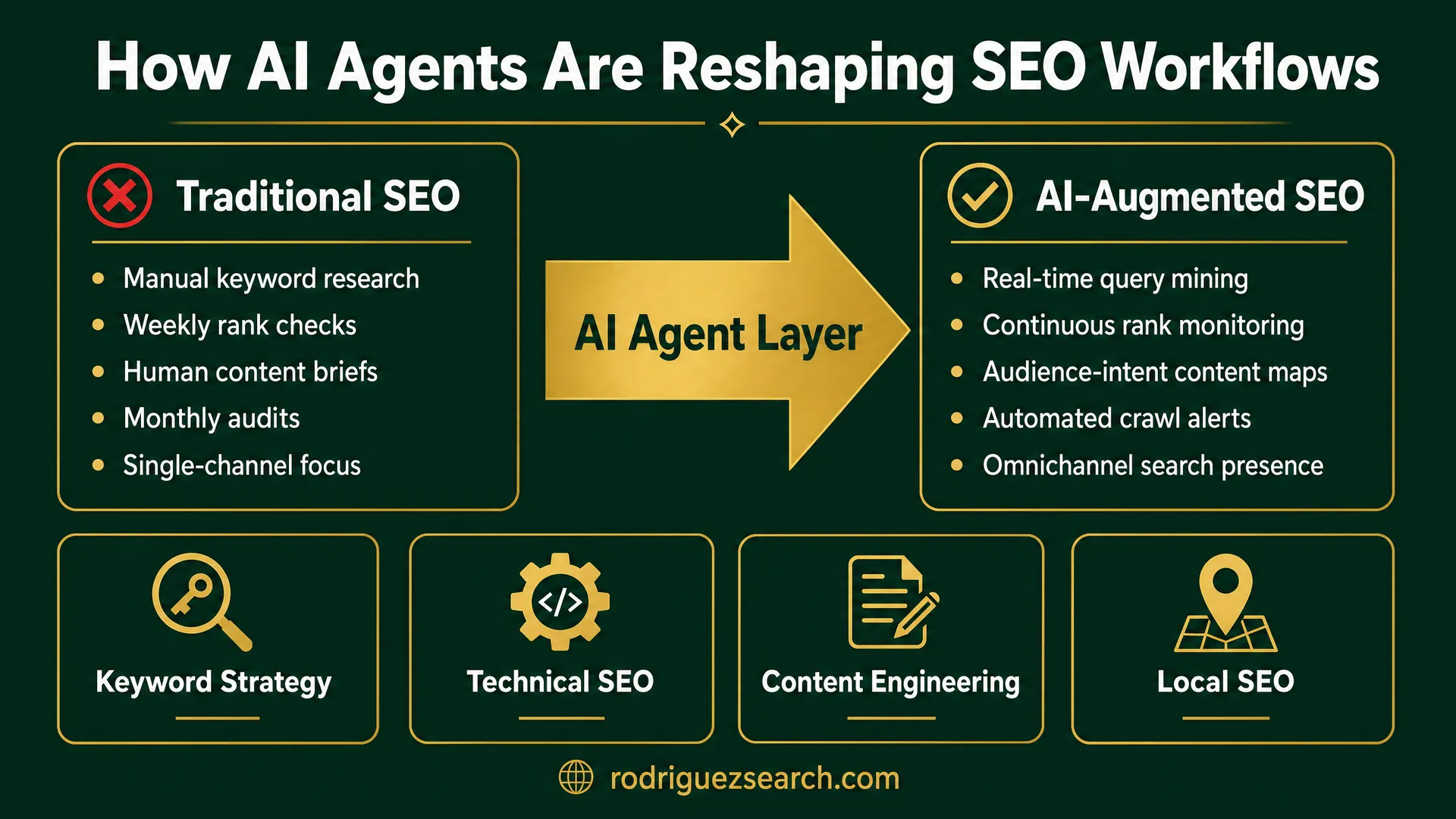
For SEO, the practical reality is more nuanced than the hype. AI agents are genuinely excellent at high-volume, data-intensive, repetitive tasks: crawling thousands of pages for technical SEO issues, monitoring rank fluctuations across hundreds of target queries, processing competitor content at scale, and generating first-draft content briefs from keyword strategy research. They are not yet reliable for strategic decisions that require business context, audience empathy, or competitive judgment.
The firms winning in search right now are not the ones that replaced their SEO strategists with AI — they are the ones that gave their strategists AI agents as leverage multipliers, compressing weeks of research into hours and redirecting human attention toward the high-judgment work that actually moves rankings.
How AI Agents Integrate Into Every Layer of Modern SEO
Keyword Strategy: From Static Lists to Living Query Intelligence
Traditional keyword research produces a spreadsheet that ages the moment it's exported. AI agents can continuously mine search query data, monitor SERP feature changes, and flag emerging queries before competitors discover them. Our keyword strategy service now integrates real-time query intelligence alongside the full-funnel intent classification that has always been our foundation — so your content targets what your audience is searching for today, not six months ago.
Technical SEO: Continuous Crawl Monitoring Instead of Quarterly Audits
A quarterly technical audit is a snapshot of a site's health at one moment in time. AI agents can monitor crawlability, Core Web Vitals, structured data validity, and internal link integrity on a continuous basis — surfacing issues within hours of a deployment rather than weeks later. Our technical SEO audit service uses this continuous monitoring layer to deliver prioritized remediation roadmaps that reflect the site's current state, not its state at the last scheduled check. For law firms specifically, this means crawl issues that would have caused pages to drop out of the index — like the robots.txt blocking we recently resolved — are caught and fixed before they affect rankings.
Content Engineering: Audience-Intent Mapping at Scale
The most time-intensive part of content engineering has always been the research phase: understanding how a specific audience — say, a personal injury plaintiff in Coral Springs — searches across the full marketing funnel from first awareness through hiring decision. AI agents compress that research dramatically, processing thousands of SERPs, competitor pages, and forum discussions to surface the exact language, concerns, and questions your ideal audience uses at each funnel stage. The strategic layer — deciding which content to create, in what format, for which audience segment — remains a human judgment call. But the data that informs that judgment is now richer and faster than it has ever been.
Topical Authority: AI-Assisted Cluster Architecture
Building topical authority requires mapping every subtopic, related entity, and semantic relationship in your niche — then building a page architecture that covers them comprehensively. AI agents can analyze competitor content clusters, identify topical gaps, and model the internal link structures that correlate with strong topical authority scores. This accelerates the cluster-building process while ensuring no high-value subtopic is missed.
Local SEO and Google Business Profile: Real-Time Pack Intelligence
For law firms and local businesses, the local pack is often more valuable than organic rankings. AI agents can monitor local pack positions across multiple practice areas, cities, and query variants simultaneously — something that would require dozens of manual rank checks per week to replicate manually. Our local SEO service uses this monitoring layer to detect pack fluctuations early and respond with targeted GBP optimizations before a competitor consolidates a position.
AI Search Everywhere: Optimizing for the Platforms Your Clients Actually Use
Your potential clients are not only searching on Google. They are asking ChatGPT, Perplexity, Claude, and Gemini for attorney recommendations. They are watching YouTube videos and reading Reddit threads. Our AI Search Everywhere service ensures your brand and expertise appear across all the surfaces where AI agents retrieve and surface answers — not just the traditional Google blue links.
What This Means for Law Firms in South Florida Right Now
The Broward County legal market is competitive precisely because it is geographically concentrated and practice-area-specific. A personal injury firm in Coral Springs is not competing with every personal injury firm in the United States — it is competing with 15–20 firms within a 10-mile radius, all targeting the same local pack positions and the same AI Overview citations.
The firms that will dominate local search in 2026 and beyond are those that combine three things: a technically sound website that AI agents can efficiently crawl and parse; a content cluster that covers every practice area and audience intent comprehensively enough to be cited by AI Overviews; and a Google Business Profile that signals active, authoritative local presence. None of these require a massive budget — they require a coherent strategy executed consistently.
If you are a law firm in Coral Springs, Pembroke Pines, or Fort Lauderdale, the window to build that foundation before your competitors do is narrowing. The AI agent layer is not coming — it is already here, and it is already deciding which pages get cited and which get ignored.
Frequently Asked Questions
What is an AI agent in the context of SEO?
An AI agent is an autonomous software system that can perceive its environment, make decisions, and take actions without constant human input. In SEO, AI agents are used to continuously monitor rankings, crawl websites for technical issues, mine search queries in real time, generate content briefs, and flag optimization opportunities — tasks that previously required hours of manual analyst work.
Will AI agents replace SEO professionals?
No — AI agents replace repetitive, data-heavy tasks, not strategic judgment. An AI agent can tell you that 47 pages have missing H1 tags; it cannot tell you which of those pages represent your highest-value conversion opportunities or how to reposition your topical authority to outrank a competitor with 10x your domain authority. Strategy, audience understanding, and business context remain human responsibilities.
What is Agentic Engine Optimization (AEO)?
Agentic Engine Optimization (AEO) is a framework introduced by Google Cloud AI's director of engineering Addy Osmani in April 2026. It refers to structuring and serving content so AI agents can efficiently fetch, parse, and act on it — including token efficiency, front-loading answers within the first 500 tokens, clean semantic HTML, and machine-readable discovery layers like llms.txt.
How does AI agent SEO help law firms specifically?
Law firms benefit from AI-augmented SEO in three key areas: (1) Local pack monitoring — AI agents track Google Business Profile ranking fluctuations in real time across multiple practice areas and cities; (2) Technical crawl alerts — automated detection of crawlability issues that would otherwise take weeks to surface in a manual audit; (3) Content gap analysis — continuous comparison of your content cluster against competitor pages to identify missing topics before they cost you rankings.
How do I optimize my website for AI agents and AI search?
The core principles are: use clean semantic HTML with proper heading hierarchy (H1→H2→H3), front-load answers in the first paragraph, keep pages within token-efficient length ranges, implement structured data (Schema.org), build a clear internal link architecture so agents can navigate your content cluster, and ensure your Google Business Profile is fully optimized for local AI overviews.
Ready to Future-Proof Your SEO?
Let's Build an AI-Ready Search Strategy for Your Firm
From technical foundations to content clusters to local pack dominance — we integrate AI agent capabilities into every layer of your SEO strategy so you stay visible wherever your clients are searching.